Punjab’s ₹1000 Scheme for Women: Welfare Support or Political Timing?
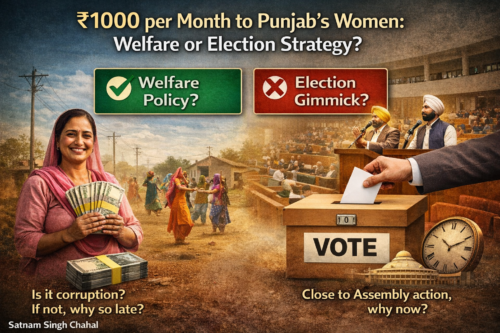 The announcement of ₹1000 per month for women in Punjab has sparked intense debate across political and public circles. The scheme, introduced by the government led by Chief Minister Bhagwant Mann, is being projected as a major step toward women’s empowerment and financial support for families struggling with rising living costs. However, the timing and implementation of the scheme have raised serious political and ethical questions, with critics asking whether it represents genuine welfare policy or a politically motivated move ahead of electoral contests.
At the heart of the debate lies a crucial question: Is the financial assistance scheme corruption? From a legal and administrative perspective, welfare schemes announced through government budgets or policy decisions cannot automatically be labeled corruption. Governments across India have introduced direct benefit programs to support vulnerable groups. As long as funds are allocated through the official budget process and distributed transparently, such initiatives fall under public welfare policy rather than corruption.
However, critics argue that the real issue is not legality but political timing and credibility. The promise of financial assistance to women was made by the Aam Aadmi Party during the 2022 Punjab Assembly elections. The party had assured voters that women above the age of 18 would receive ₹1000 per month soon after the formation of the government. Yet, nearly four years passed without the scheme being implemented in full.
Opposition leaders, including senior Congress MLA Sukhpal Singh Khaira, have repeatedly questioned why the government delayed the program for so long if it was genuinely intended as a welfare measure. According to critics, if the government had the financial capacity to implement the scheme, it should have been introduced earlier instead of being revived close to important political moments in the state.
This has led to a broader political argument that the announcement may be designed to influence public sentiment ahead of future electoral contests. In many democracies, including India, opposition parties frequently accuse governments of using welfare announcements strategically to strengthen voter support before elections. While such actions may not fall under the legal definition of corruption, they often raise concerns about political populism and the use of public funds for electoral advantage.
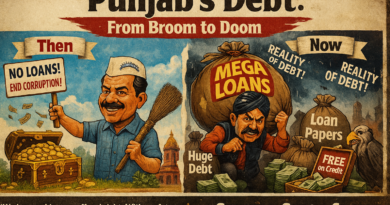
Another dimension of the debate involves Punjab’s fragile financial condition. Economists and policy analysts have repeatedly warned that the state faces serious fiscal challenges, including rising debt and limited revenue growth. Critics therefore argue that before announcing large-scale financial assistance schemes, the government must clearly explain how the program will be funded without worsening the state’s debt burden.
Supporters of the scheme, on the other hand, argue that financial assistance to women is a progressive social policy rather than a political tactic. They say direct cash transfers can help women achieve greater financial independence, support household expenses, and improve living conditions in economically weaker families. Many social welfare programs in India and around the world are designed on similar principles.
The debate surrounding the ₹1000 scheme ultimately reflects a larger tension in democratic politics between welfare governance and political strategy. Welfare programs are essential for social justice and economic support, but their credibility depends on consistent implementation, transparency, and timely delivery of promises made to voters.
For many citizens of Punjab, the real question is not only whether the scheme is corruption or not. Instead, it is about trust in political promises. When a government makes commitments during elections, people expect those promises to be fulfilled within a reasonable timeframe. Delays followed by sudden announcements close to politically sensitive periods naturally lead to skepticism and public debate.
As Punjab continues to navigate economic challenges and political competition, the success or failure of such welfare initiatives will depend on how effectively they are implemented and whether they genuinely improve the lives of the people they are intended to help. Ultimately, transparency, accountability, and timely action remain the key factors that determine whether a policy is seen as genuine public welfare or merely political timing.